|
Fr. Brian Cavanaugh, TOR © October 2026
The testing of faith does not mean that God needs hardship to discover whether our faith is genuine. Rather, trials may bring what is already within us into the open. They reveal where we are relying on and can deepen our trust in God. Reflecting on Abraham’s trial in Hebrews 11, John Chrysostom explains that God did not test Abraham to learn something previously unknown, but “to make Abraham’s fortitude manifest to others.” Chrysostom then applies the lesson pastorally: trials do not mean that people have been abandoned by God. They can become occasions in which faithfulness, often quiet and unseen, is made visible.3 Endurance is more than gritting your teeth. It is patient perseverance: remaining faithful without allowing adversity to turn us toward despair, bitterness, or wrongdoing. This does not mean that we never feel afraid or discouraged. It means that fear and discouragement do not have to determine the next choice.4 5 A reflection attributed to St. Padre Pio puts the call to perseverance this way: Gumption and Fortitude After four major knee surgeries in two years, the last being a total knee reconstruction, one word kept me focused during rehabilitation: “gumption.” It means determination full of courage joined with common sense.7 I needed determination to keep going, to respect the limits of recovery, to follow the process, and to accept that healing would not happen on my preferred timetable. That experience helped me recognize something close to the cardinal virtue of fortitude. Catholic teaching describes fortitude as firmness in difficulty and constancy in pursuing the good. It is not simply charging ahead.8 9 Sometimes courage means acting when something good must be defended; at other times, it means patiently enduring what cannot be quickly changed. Gumption is a plainspoken word, not a theological term for fortitude. It captures the grit to keep going. Fortitude gives courage a moral direction: pursuing what is truly good, guided by right judgment rather than by bravado. Ordinary human courage matters, and Christian fortitude is lived in faith and charity, relying on God’s grace.10 Fortitude does not abolish fear. In Christian life, fortitude serves all the virtues: it helps a person remain faithful to justice, charity, and other goods when they become costly. Its most dramatic expression may be giving one’s life for a just cause, but it is also present in the quieter perseverance of ordinary life.11 12 When the Struggle Is Personal The struggle with pornography offers one concrete example of “when your faith is tested.” The Church teaches that pornography violates chastity and the dignity of the people involved. Chastity integrates sexuality into the whole person and supports self-mastery and genuine freedom. Chastity is not contempt for sexuality; it is learning to see yourself and other people as whole persons, worthy of love and respect. In addition, the Church also notes that personal responsibility can be diminished by factors affecting knowledge or freedom.13 14 15 Fortitude helps a person persevere in chastity when temptation or discouragement makes that difficult. Fortitude is that determination ordered toward what is truly good. When temptation comes, fortitude doesn’t mean pretending it is easy or trying to prove you are strong. It means choosing a wise response, getting help when you need it, and, if you fall, beginning again.16 Make Fortitude Concrete The next step might mean implementing practical measures, such as, blocking tools, changing device habits, accountability, or counseling. These are supports, not guarantees or tests, of a person’s sincerity. They are actions of prudence and courage. The USCCB specifically recommends ongoing support and notes that monitoring or blocking software may be necessary to avoid occasions of sin.17 These practical measures are not signs of weakness. They are ways of acting prudently rather than relying on a burst of resolve in the most difficult moment. Fortitude is not recklessness or self-punishment; it is steadfastness in the good.18 Success does not mean never experiencing temptation. It means learning to respond faithfully when temptation arises and wisely continuing to grow in chastity. If a fall happens, it matters, but it does not have to become a verdict on the whole person. Seek God’s mercy, return to confession, learn what can be learned, and take the next concrete step. Patience and perseverance include a willingness to begin again.19 20 Repentance Without Self-Condemnation I have seen how a fall can become more than “I did something wrong;” it can become ‘This proves I am disgusting, a failure, or incapable of change.’” Feeling shame is not itself always the same as self-hatred or despair. When shame becomes a verdict on the whole person, it can draw a person into secrecy and hopelessness. The USCCB’s pastoral response warns that shame, fear, and despair can keep people from turning to Christ’s mercy and help.21 Sin must be taken seriously, but no failure makes a person hopeless. Contrition is not self-hatred. It is the honest recognition that I have done wrong and the desire to turn back to God. Self-condemnation says something very different: “I am nothing but this failure, and there is no point in trying again.” Christian repentance calls us away from sin and toward mercy, conversion, and hope.” In the Franciscan tradition, that conversion is meant to be humble, gentle, peaceful, and merciful, not harsh, nor performative, nor self-loathing.22 There is a verse from the Book of Hebrews that I keep handy, both as a reminder to myself and as a source of hope for others: “But encourage one another day after day, as long as it is still called ‘Today,’ so that none of you will be hardened by the deceitfulness of sin” (Hebrews 3:13 (NASB1995).23 Shame and self-loathing can harden one’s spirit against the possibility for ongoing conversion. Honest repentance, by contrast, keeps the door open to God. Catholic repentance involves honest sorrow for sin, and a firm resolve to turn away from sin, but it is also “nourished by hope in God’s mercy.”24 Repentance is not endless self-punishment. It turns us toward the Lord and toward the next step of healing.25 That turning is not something we have to do alone: it is a response to Jesus, who calls us into communion with him. He says, “Listen! I am standing at the door, knocking; if you hear my voice and open the door, I will come in to you and eat with you, and you with me” (Rev 3:20).26 We hear in these words an invitation to welcome Christ more fully into our lives — to let him meet us in our struggle, receive his mercy, and walk with him as we begin again.27 A fall matters, but it does not have the authority to define you or decide your future. Don’t hide. Tell the truth, receive mercy, and take the next step. That does not excuse sin. It refuses to let sin have the last word. The Church urges those who fall to rise again, seek God’s mercy, and continue patiently with practical and spiritual support.28 When someone feels hopeless that pain deserves to be met with compassion rather than an immediate accusation of despair. Feeling crushed or unable to feel hope is not necessarily a deliberate rejection of God’s mercy. Christian hope does not rest on a flawless record; it rests on God’s goodness and the possibility of conversion. The Catechism describes hope as confident expectation of God’s blessing and teaches that repentance is sustained by hope in divine mercy.29 30 If hopelessness, however, includes thoughts of self-harm, it is an urgent safety concern and calls for appropriate professional help and support from trusted people. Confession or spiritual counsel alone is not an adequate response to immediate danger.31 Sport Can Make Virtue Concrete Sport can make virtue concrete. The Church’s reflection on sport describes it as a way to introduce young people to the virtues of fortitude, temperance, prudence and justice. It also recognizes the importance of movement, play and sport for the holistic development of the personality of young people. …”32 Courage is not simply doing what is easiest or most expedient; perseverance often becomes most visible in defeat and difficulty.33 Pope Francis34 used athletic training as an image for growth in virtue and for the journey of getting up after a fall, receiving help, and continuing the journey. The encouraging language of incremental improvement is helpful, too, so long as those who struggle clearly understand that they are not earning God’s love by improving their performance.35 A good coach does not confuse a player’s mistake with the player’s worth. The coach helps the player to face the mistake truthfully and prepare for the next play. That is a helpful image for the spiritual life, too. We can acknowledge what went wrong without declaring ourselves beyond repair. The next step toward chastity and freedom need not be dramatic. It may be one practical change, an honest conversation with someone trustworthy, or the decision to seek help. If a fall occurs, the journey is not over. Return to God, receive His mercy, learn from what happened, and begin again. The aim is not a perfect record, but a steadfast life becoming more fully alive in the gifts God gives: courage, humility, and hope.36
2. Balthasar, Hans Urs von, “Joy and the Cross” Communio: International Catholic Review, vol. 31, pp. 332-34, 2004. 3. Chrysostom, John, Homily 25, :Hebrews 11:17-19, §2", Trans. Frederic Gardiner, From Nicene and Post-Nicene Fathers, First Series, Vol. 14. Edited by Philip Schaff. (Buffalo, NY: Christian Literature Publishing Co., 1889.) Revised and edited for New Advent by Kevin Knight. 4. Balthasar, “Joy and the Cross.” 5. Cyprian of Carthage, “The Treatises of Cyprian — Treatise XI,” Trans. Robert Ernest Wallis, From Ante-Nicene Fathers, Vol. 5. Edited by Alexander Roberts, James Donaldson, and A. Cleveland Coxe, (Buffalo, NY: Christian Literature Publishing Co., 1886.) Revised and edited for New Advent by Kevin Knight. 6. “Padre Pio’s Words of Faith,” Padre Pio Devotions, accessed October 28, 2026. 7. Vocabulary.com, Gumption, Accessed 11 Mar. 2024. 8. CatholicCulture.org, Catechism of the Catholic Church, “Part Three: Life in Christ, Section One Man’s Vocation Life in the Spirit, Chapter One the Dignity of the Human Person, Article 7 the Virtues, I. The Human Virtues §1808, Fortitude,” English Translation of the Catechism of the Catholic Church for the United States of America © 1997, United States Catholic Conference, Inc. 9. Rickaby, John. “Fortitude,” The Catholic Encyclopedia Vol. 6, New York: Robert Appleton Company, 1909. 10. Marshall, Bruce D. “Religion and Election: Aquinas on Natural Law, Judaism, and Salvation in Christ,” p. 23, Nova et Vetera, English Edition, vol. 14, no. 1, St. Paul Center for Biblical Theology, 2016. 11. Promulgated by Pope Benedict XVI, Compendium of the Catechism of the Catholic Church. Libreria Editrice Vaticana, “Section One: Man’s Vocation — Life In the Spirit, Chapter One: The Dignity of the Human Person, The Virtues,” §382. “What is fortitude?” 12. Pope John Paul II, General Audience, p. 1, Libreria Editrice Vaticana, 1978. 13. Hütter, Reinhard, “Pornography and Acedia”, First Things, April 1, 2012. 14. USCCB, Create in Me a Pure Heart: A Pastoral Response to Pornography, “II. The Beauty and Vocation of the Human Person in Christ,” “Chastity,” p. 9. 15. Ibid., “III. Shedding Light on the Sin of Pornography, p. 11.” 16. Ibid., “Why Pornography Is an Offense Against Chastity and Human Dignity,” p. 12. 17. Ibid., “VI. The Church as a ‘Field Hospital’: Mercy, Healing, and Hope Through Christ,” p.24. 18. The Catholic Encyclopedia Vol. 6, “Fortitude.” 19. Ibid. 20. Ibid. 21. USCCB, “VI. The Church as a ‘Field Hospital’: Mercy, Healing, and Hope Through Christ” p. 24. 22. Francis of Assisi, The Rule of the Franciscan Order (Rule of St. Francis), §III “Concerning the Divine Office and Fasting; and How the Brothers Ought to Travel Through the World,” 1223. 23. Biblegateway.com, “Hebrews 3:13,” New American Standard Bible, Copyright © 1960, 1971, 1977, 1995 by The Lockman Foundation. All rights reserved. 24. Joe Paprocki, Catechist’s Journey, The Act of Contrition and the Sacrament of Penance, Loyola Press. 25. Synod of the Ukrainian Greek Catholic Church. Catechism of the Ukrainian Catholic Church: Christ – Our Pascha, §783, p. 254, 2016. 26. The Holy Bible, “Revelation 3:20”, NRSVCE New Revised Standard Version Bible: Catholic Edition, copyright © 1989, 1993 the Division of Christian Education of the National Council of the Churches of Christ in the United States of America. Used by permission. All rights reserved. 27. USCCB, “VI. The Church as a ‘Field Hospital’: Mercy, Healing, and Hope Through Christ.” 28. Ibid, 29. CCC, §2090, “§2090, Hope is the confident expectation of divine blessing." 30. CCC, §1490, “Conversion and Repentance,” 31. USCCB, “VI. The Church as a ‘Field Hospital’: Mercy, Healing, and Hope Through Christ.” 32. "The Dicastery for Laity, Family and Life, Giving the Best of Yourself:" "A Document on the Christian Perspective on Sport and the Human Person, §5.2 “Sport is at Home in the Church – Sport and Catholic Education,” June 1, 2018, Libreria Editrice Vaticana. 33. Ibid., §3.7 “Courage.” 34. Pope Francis, Christus vivit, §227, “Chapter Seven - Youth Ministry - Areas needing to be developed,” Vatican City: Libreria Editrice Vaticana, 2019. 35. Pope Francis, Acta Apostolicae Sedis: Issue 8, p. 64, August, 2023, Libreria Editrice Vaticana. 36. Pope Francis, Christus vivit. 37. BibleGateway.com,
The Holy Bible,
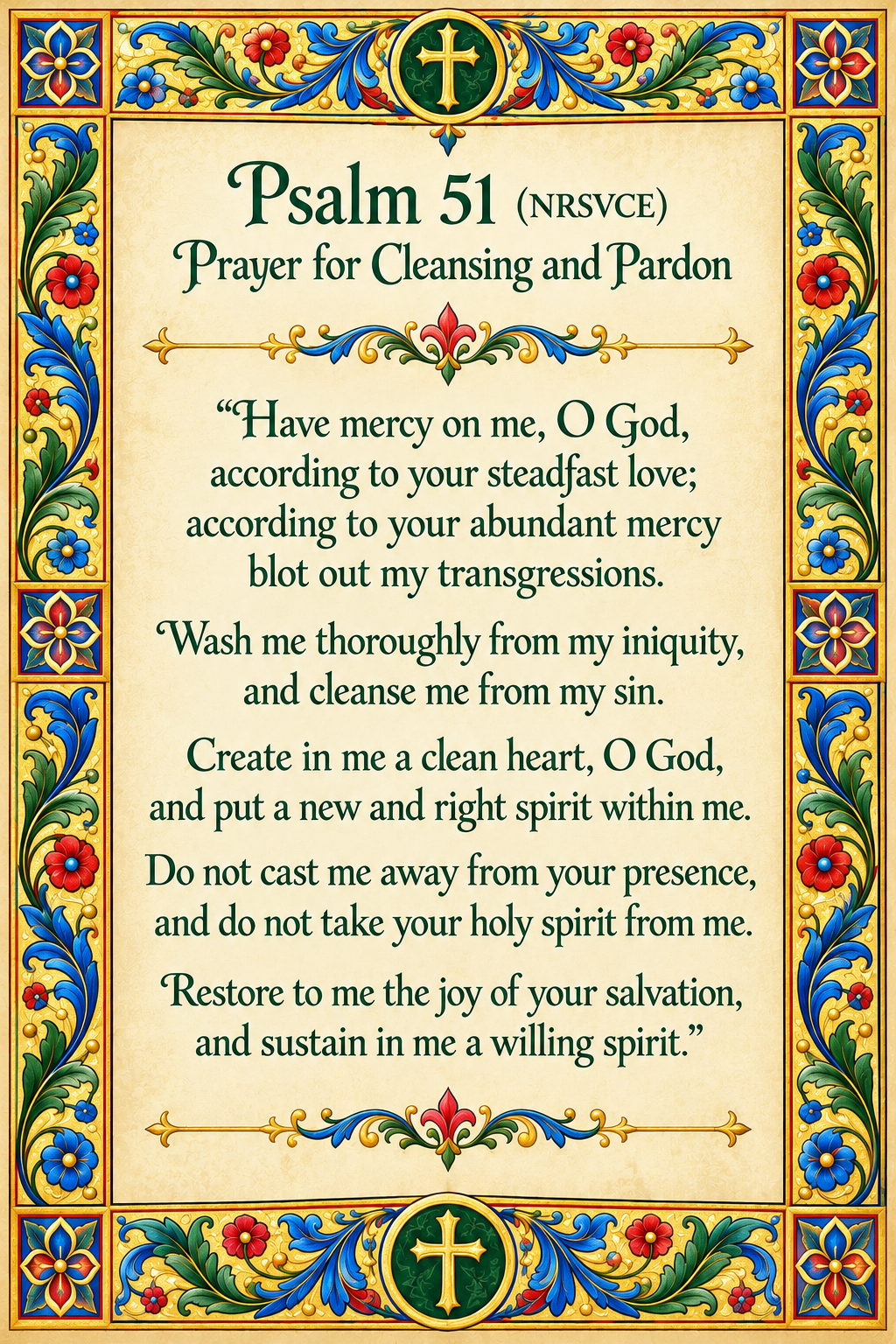
“Psalm 51:1-2, 10-12,“Psalm 51:1-2, 10-12” The New
Revised Standard Version, Catholic
Edition (NRSV-CE), 1993.
|